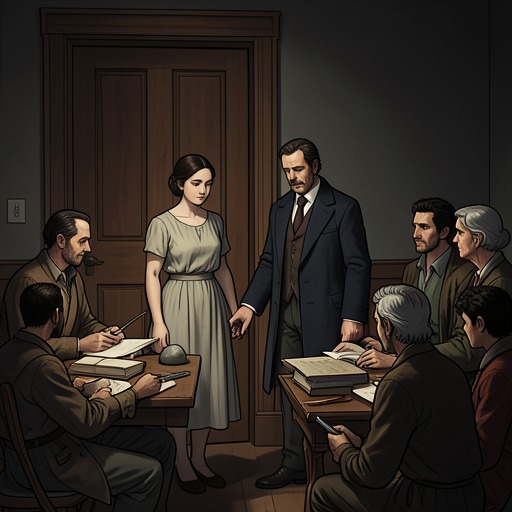
Noble duty
Just DesertsNoblesse oblige is not merely a claim to social superiority but an obligation to act on behalf of those whose lives depend on privilege. In the novel, gentle birth carries duties toward tenants, servants, vulnerable women, estates, and the future; its truest measure is therefore practical service rather than manners, clothing, or rank.
Definition and Moral Standard
Sir David Pentland gives the principle its clearest formulation when he describes Elizabeth Bennet as radiating noblesse oblige. Her status is modest—she is gently born from a minor squire—but her conduct reveals that birth has taught her responsibility rather than entitlement. To belong to an estate means accepting obligations to the people who depend upon it, not merely enjoying a larger house, better clothing, or additional social distinction. Sir David defines the duty concretely as providing extra food or clothing in a basket for tenants when circumstances require it.
This standard also exposes the moral weakness of Thomas Bennet. His books and academic interests are genuine, but his estate is not his focus. He does what is necessary and no more, leaving its potential and its dependants insufficiently served. His indolence eventually costs him the respect of Elizabeth, even though she still loves him. The contrast is not between intelligence and ignorance, but between private cultivation that remains in a study and knowledge converted into public responsibility.
Elizabeth Bennet and Practical Stewardship
Elizabeth learns the ethic through sustained work rather than formal instruction. Jane Bennet began tenant visits at twelve, and Elizabeth accompanied her at ten; the tenants themselves taught the sisters how to help them. Elizabeth later applies what she learned from Lady Radha Pentland and from visits to Grenadine Reef to the management of Longbourn. Earlier mistakes become lessons, and repeated attention makes assistance more efficient and more beneficial to the tenants.
Her stewardship is deliberately quiet. She does not announce her achievements, and the household understands their scale only after she leaves. At Longbourn, Jane Bennet and Mary Bennet work tirelessly, yet the estate produces less than it should because so much of Elizabeth’s work had taken place behind the scenes. With two fewer people in the household there is still enough food, but the prevailing feeling is that the estate ought to produce more. The novel thus makes absence a practical test of duty: when the person who has been carrying responsibility disappears, the weakness of the institution becomes visible.
Elizabeth’s refusal of William Collins is also connected to this moral framework. She rejects the idea that a bride can be bought or forced for the sake of Longbourn’s future. Her argument invokes the biblical injunction that parents must not provoke their children to anger, alongside the principle that a woman must freely consent to marriage. Noblesse oblige does not require Elizabeth to sacrifice her person to preserve an estate governed without love or proper care; responsibility toward property cannot erase responsibility toward the individual who is expected to sustain it.
Sir David Pentland and the Ethics of Action
Sir David Pentland embodies the active form of aristocratic responsibility that Elizabeth admires. Although Elizabeth’s father and Sir David both possess estates and are well read, Sir David acts while Thomas Bennet remains surrounded by books. His conduct extends beyond estate administration. When young women leave the Grenadine Reef dower house, he arranges for three to travel together so that two can return safely, and he pays five post-coach fares so that Violet Harkness, Gladys Smith, and Yvonne Smith are not left to travel alone. The practice treats protection as a continuing institutional duty rather than a sentimental gesture.
His marriage offers another challenge to conventional hierarchy. Sir David openly acknowledges that Lady Radha Pentland has a better head for business and investments than he does, and that her attention made the family prosperous. The admission matters because the surrounding social assumption is that men are better at business. His noblesse oblige therefore includes the humility to recognize competence wherever it exists and to let effective stewardship outrank gendered pride.
Elizabeth’s understanding of the ideal gentleman is shaped by these examples. Through her volunteer work at the Asylum for Female Orphans, she sees vulnerable girls as younger versions of the women protected at the Grenadine Reef dower house. In her moral imagination, the highest and most complete gentleman is one who acts and makes an effort for those less fortunate than himself. Sir David’s example gives the principle its fullest force: inherited standing becomes honorable only when it is spent in protection, relief, and sustained administration.
Estates, Contracts, and Succession
Noblesse oblige reaches beyond individual benevolence into questions of ownership and governance. Sir David’s mortality makes the future of his estate urgent. When Vivian Harkness asks what will happen to the estate after his death, the question is improper for a servant, yet it identifies the central practical danger: a household and refuge cannot depend indefinitely on one aging man. Sir David is already slower, more frail, and easily chilled, and he knows that a solution is needed before time removes his remaining choices.
His response is a plan intended to protect Elizabeth, Grenadine Reef, and its smaller estates. He explains that Lady Radha Pentland may have begun considering Elizabeth’s future within a year of meeting her, while his own concern sharpened after Lady Radha’s death and after Elizabeth’s need to reach adulthood and escape Mrs. Bennet. Terminal stomach cancer compresses the timetable. What might have been arranged gradually must instead be secured through a new will, a marriage settlement, and a wedding, with James Pentland as witness and medical and magistrate attestations confirming Sir David’s sound mind.
The settlement expressly preserves Elizabeth’s authority. Although marriage would ordinarily give a husband control over the assets a woman brought into the union, any matter concerning Grenadine Reef or the smaller estates is to require Elizabeth’s explicit written permission. During Sir David’s and Fitzwilliam Darcy’s lifetimes, she is to be the real mistress of the estate regardless of the formal legal position. The arrangement converts an ethical conviction into a contractual safeguard: responsibility is matched with control, and Elizabeth is not asked to manage property while being deprived of the authority needed to protect it.
The same principle appears in Fitzwilliam Darcy’s decision to acquire the remainder of the Netherfield Park lease from Charles Bingley. He keeps his name out of the transaction through his solicitors, bargains hard because two-thirds of the lease has already elapsed, and then devotes at least half of each day to the estate. His motives include remaining near Elizabeth Bennet, making her happy, relieving his conscience, and allowing the tenants to experience a landlord rather than endure another vacant period. Spring planting and harvest work follow, and Netherfield becomes a place where estate labor is not treated as a chore.
Contrast, Consequence, and Significance
The novel places successful stewardship beside Longbourn’s decline. Grenadine Reef and Pemberley run smoothly because their management is active and attentive; Longbourn reflects its master’s failure to care. This is a critique of passive privilege: an estate does not flourish simply because its owner possesses education, lineage, or legal title. Information, supervision, labor, and concern must move through the household if the property is to serve the people attached to it.
The principle also governs the treatment of inheritance. The Bennet family traces its succession from Martin Bennet, who received the deed to Longbourn and its attendant lands from Charles II, through legal documents, parish records, and the Bennet Family Bible. When the last male heir dies without male issue, the entail is broken. The discovery changes property from an apparently fixed male inheritance into a responsibility that can be reorganized. The legal history matters because noblesse oblige is not suspended by custom: once the inherited structure no longer serves its stated purpose, the living must make a more responsible arrangement.
In this sense, noblesse oblige is both a social ideal and a test that exposes hypocrisy. It condemns the owner who does only what is necessary, the gentleman who abandons an estate, and the family that values Longbourn above a daughter’s freedom. It honors the people who feed, protect, supervise, and plan. The novel’s most consequential reversal is that the supposedly subordinate woman becomes the clearest bearer of aristocratic duty: Elizabeth Bennet does not inherit authority simply as a reward for birth, but earns and exercises it by making privilege answerable to human need.